Creative Strategy for Player Retention
Warner Bros. Games is a leading video game publisher and developer for its blockbuster IPs and licensed franchises such as DC Comics, Harry Potter, Lego, and Game of Thrones.
The client was looking to increase player retention and re-engagement in their mobile game Game of Thrones: Conquest. The client needed a creative strategy that could effectively re-capture lapsed users' attention and bring them back into the game.
The Design Challenge - We began by analyzing player behavior data, such as favorite characters, churn points, and popular features, to inform strategy. In this case, the available data was limited, so we leaned into testing and creative exploration to guide our direction. On top of that, their game engine couldn’t be reproduced within our ad coding environment, which meant we had to find innovative workarounds to bring the gameplay experience to life.
I collaborated with our account management and business intelligence teams to align with the client on their campaign goals. From there, I led the creative team in developing a robust concept that showcased multiple facets of gameplay, from strategic combat and kingdom building to dragon training and character development.
The Solution - To work around the technical limitations and limited client data, I proposed a modular creative strategy built around key gameplay features. Instead of focusing on just one angle, we developed a series of creative variants designed to highlight different aspects of the game experience and test what would drive the most engagement.
We started by building out storyboards and wireframes using a combination of in-game screenshots and official artwork. Once approved, we moved forward with high-fidelity mockups and began animating and coding the final ad units.
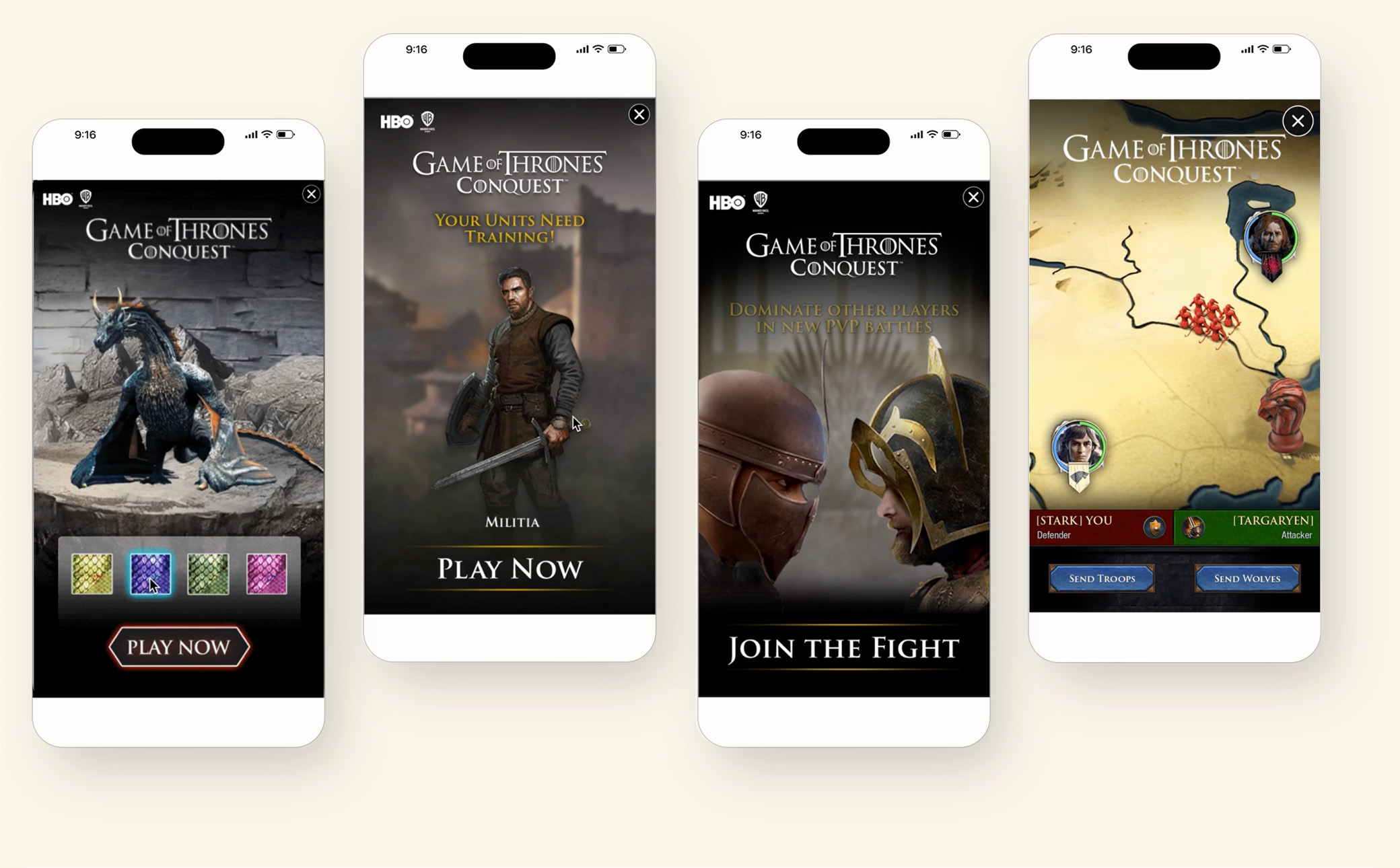
The result was a suite of distinct, visually rich formats:
- An interactive dragon carousel, that allowed users to view 3D dragons and experiment with color customization.
- A battle simulation demo, showcasing new gameplay modes with animated troop movement and tactical overlays.
- A quick animated teaser, emphasizing the thrill of combat and the launch of the new battle feature.
- A character and inventory carousel, highlighting new heroes, units, and items available in the game.
Each piece was optimized for performance, built to run smoothly across devices, and designed to mirror the immersive feel of the Game of Thrones world, without relying on direct integration with the game engine.
This project highlighted the value of testing different features and messaging angles within a single campaign. By diversifying the creative types, video, carousel, and interactive, we increased the chances of connecting with different user motivations. It also reinforced the importance of adaptability: when the game engine couldn’t be replicated in our playable environment, we leaned on the interactive tools we had available and recreated a simplified version of the gameplay to deliver an experience that still felt compelling and authentic.
By building a variety of engaging, feature-led ad experiences, we created a flexible toolkit the client could expand on, and laid the foundation for future performance optimization through creative testing.